New York is moving to enforce one of the country’s most significant AI safety laws, putting large frontier developers such as OpenAI and Anthropic under a new layer of state oversight. The state opened a registration portal Tuesday as the RAISE Act approaches its effective date, with the first compliance deadline for covered companies set for January 1, 2027.
What the RAISE Act requires from frontier AI developers
The RAISE Act is New York’s safety and transparency bill aimed at large frontier AI developers, defined in the source material as companies with more than $500 million in annual revenue. Under the law, those firms must publish safety frameworks on their websites, report critical safety incidents within 72 hours, and issue public model transparency reports.
The new portal gives the state a mechanism to track which companies fall under the law and whether they have met the registration requirement. According to the source material, developers like OpenAI and Anthropic will need to register by January 1, 2027.
New oversight structure under DIGIT
Enforcement will be handled by the newly formed Office of Digital Innovation, Governance, Integrity, and Trust, or DIGIT. The office will oversee large frontier AI labs and implement the RAISE Act, giving New York a dedicated state body focused on this category of AI oversight.
The law also gives the state meaningful enforcement power. Penalties can reach $1 million for a first violation and $3 million for subsequent violations. The state may also bring enforcement actions against companies that fail to register through the new portal, although a spokesperson declined to provide details about how those actions would work in practice.
Hochul frames the law as a counterweight to AI hype
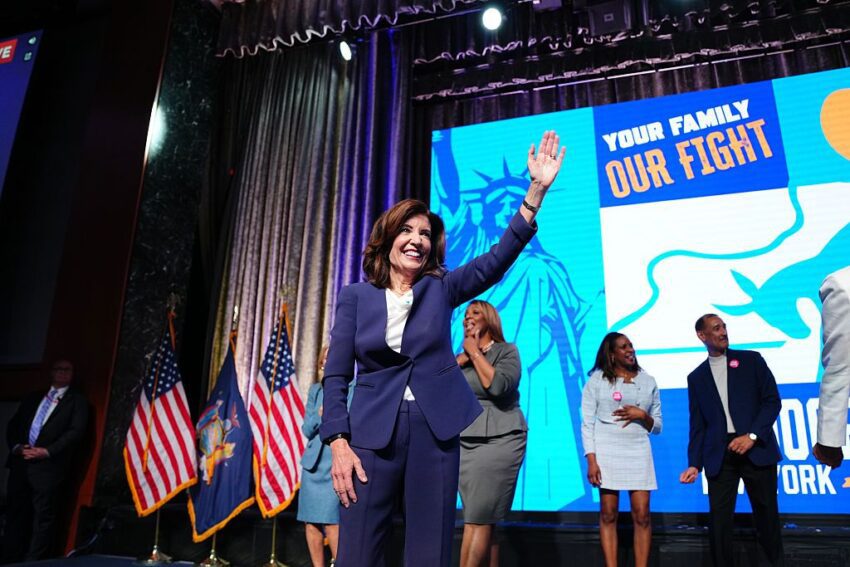
Governor Kathy Hochul used Tuesday’s briefing to cast the law as a response to the pressure governments face from AI companies and their supporters. “Tech moguls tell us that their vision for AI is inevitable,” Hochul said. “They tell us get on board or get left behind… That any collateral damage is worth it as long as we win the race to the AI cliff.”
She also said New York is trying to set a national standard for regulation. “We’re building a national model for smart, sensible AI regulation, a model that puts communities above corporations and people above powerful technology,” Hochul said.
In the same announcement, Hochul launched the New York Center for AI Responsibility and Research at State University of New York’s Binghamton University. The center will independently evaluate the safety, security, and operation of advanced AI systems and work with DIGIT to review companies’ safety frameworks. Hochul first announced the center in January with $55 million in donations and capital.
How the New York Center for AI Responsibility and Research fits in
The new research center adds an independent technical layer to the state’s regulatory approach. Based at SUNY Binghamton, it is intended to help assess whether companies’ safety frameworks are credible and whether advanced systems are operating as expected.
That matters because the RAISE Act is not just about paperwork. By requiring public safety frameworks and transparency reports, New York is signaling that it expects frontier labs to document how they identify and mitigate risks, and to disclose serious incidents quickly when they occur.
Key obligations under the law
- Applies to large frontier AI developers with more than $500 million in annual revenue.
- Requires safety frameworks to be published on company websites.
- Requires critical safety incidents to be reported within 72 hours.
- Requires public model transparency reports.
- Requires registration through New York’s new portal by January 1, 2027.
- Allows penalties of up to $1 million for one violation and $3 million for later violations.
Part of a broader wave of AI safety rules
New York’s law is not the only recent AI safety measure on the books. The state already began enforcing a separate law last year that requires operators of AI companions to regularly let users know they are talking to a bot. That law also requires reasonable efforts to detect suicidal ideation and self-harm.
In October, Hochul signed another chatbot safety law aimed at minors. That measure restricts deceptive human-like interactions, emotionally manipulative or sycophantic responses, and encouragement of harmful behaviors such as suicide or disordered eating. It is scheduled to take effect on June 1, 2027.
Together, these laws suggest New York is building a layered policy approach: one set of rules for high-capability frontier AI developers, and another for consumer-facing chatbot systems that may affect vulnerable users more directly.
How New York compares with California and Illinois
Other states have also enacted AI safety and transparency laws with similarities to the RAISE Act. California’s SB 53, which took effect in January, requires frontier AI labs to publish safety frameworks, provide whistleblower protections, and report critical safety incidents within 15 days. Illinois’ SB 315, which will take effect at the start of 2027, includes similar requirements and also adds independent safety compliance audits.
Those state-level laws matter because there is still no single federal AI safety regime that clearly sets the rules for frontier model developers. In the absence of a national standard, states are increasingly writing their own frameworks, and New York’s version adds both public transparency and formal oversight infrastructure.
What the registration deadline means for major labs
For OpenAI, Anthropic, and other major AI companies that meet the revenue threshold, the new portal is more than a formality. Registration is the entry point for a system that will require public disclosures, incident reporting, and ongoing scrutiny from a dedicated state office.
The practical effect is likely to be a closer look at how these companies document model risks and respond to serious safety events. Because the law calls for public transparency reports and fast incident reporting, New York is making compliance visible not only to regulators but also to the public.
At the same time, the state’s decision to create DIGIT and the AI Responsibility and Research center shows that New York wants more than passive reporting. It is building an enforcement and evaluation structure that can review safety plans, examine advanced systems, and pursue penalties when companies do not comply.
Source: Original report
Was this helpful?
Explore more: AI Automation Services More AI & Automation Tech News
Last Modified: November 11, 2026 at 10:31 pm
0 views