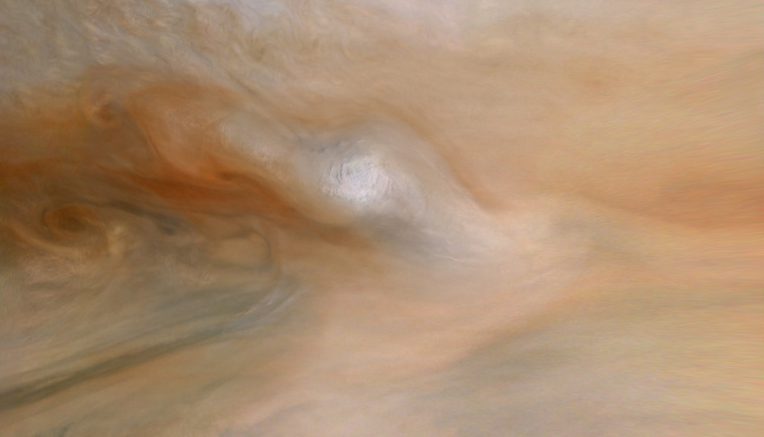
a mission nasa might kill is still NASA’s Juno spacecraft continues to provide groundbreaking insights into Jupiter’s atmospheric phenomena, revealing that the gas giant’s colossal storms generate lightning flashes significantly more powerful than those found on Earth.
a mission nasa might kill is still
Significant Findings from Juno’s Data
On March 20, researchers published their findings in the journal AGU Advances, detailing the extraordinary nature of lightning on Jupiter. The data analyzed was collected by Juno during its extended mission phase in 2021 and 2022. This phase was granted after Juno successfully completed its initial five-year science campaign, which began in 2016. The spacecraft has been instrumental in enhancing our understanding of Jupiter’s complex atmosphere and magnetic field.
Powerful Lightning on Jupiter
The study highlights that Jupiter’s lightning is at least 100 times more powerful than that of Earth. This revelation not only underscores the extreme conditions present on the gas giant but also raises questions about the underlying mechanisms that drive such intense electrical activity. The findings suggest that Jupiter’s storms are not merely larger versions of those on Earth but are governed by different atmospheric dynamics.
Data Collection and Analysis
The data used for this analysis was gathered by Juno’s Microwave Radiometer (MWR), which measures the thermal radiation emitted by Jupiter’s atmosphere. This instrument allows scientists to peer into the planet’s clouds and gain insights into its weather patterns. The MWR has been crucial in identifying the locations and intensities of lightning strikes, providing a clearer picture of the gas giant’s storm systems.
Researchers noted that the lightning detected by Juno occurs in massive storm systems that can span hundreds of kilometers. These storms are believed to be fueled by the planet’s deep atmospheric dynamics, which differ significantly from those on Earth. The intense heat and pressure within Jupiter’s atmosphere contribute to the formation of these powerful storms, which can produce lightning strikes that reach up to 1,000 times the intensity of typical Earth lightning.
The Future of the Juno Mission
Despite the exciting discoveries made by Juno, the spacecraft’s future remains uncertain. NASA officials have not yet confirmed whether they will approve another extension for the mission. The primary concern is funding, as the agency faces budget constraints that could impact ongoing and future missions.
Budgetary Concerns and Mission Viability
The uncertainty surrounding Juno’s future stems from broader budgetary issues within NASA. Nearly a year ago, the Trump administration requested that mission leaders prepare “closeout” plans for their spacecraft, including Juno. This directive raised alarms among scientists and mission planners, as it indicated potential cuts to NASA’s science budget, which was proposed to be slashed by nearly half in the administration’s budget request.
Such budget cuts would not only jeopardize Juno but also threaten more than a dozen other robotic science missions. The implications of these cuts could be far-reaching, affecting ongoing research and the future of planetary exploration. The scientific community has expressed concern that reducing funding for missions like Juno could hinder our understanding of the solar system and beyond.
Community Response and Advocacy
In response to the potential budget cuts, scientists and advocates for space exploration have rallied to emphasize the importance of missions like Juno. They argue that the data collected by Juno is invaluable for understanding not only Jupiter but also the formation and evolution of planetary systems. The insights gained from Juno’s observations can inform future missions and enhance our knowledge of planetary atmospheres, magnetic fields, and potential habitability.
Moreover, the scientific community has highlighted the importance of long-term investments in space exploration. While the initial phases of missions like Juno are crucial, the extended missions often yield the most significant discoveries. The data collected during these extended periods can lead to groundbreaking insights that reshape our understanding of the cosmos.
Implications of Juno’s Discoveries
The findings from Juno’s observations have broader implications for our understanding of planetary science. The powerful lightning on Jupiter may provide clues about the processes that govern atmospheric dynamics on gas giants. By studying these phenomena, scientists can draw comparisons with other planets, including exoplanets that may have similar atmospheric conditions.
Understanding Atmospheric Dynamics
Understanding the mechanisms behind Jupiter’s lightning can also shed light on the fundamental physics of storm systems. The extreme conditions on Jupiter challenge our current models of atmospheric behavior, prompting scientists to refine their theories and simulations. This research could have implications beyond our solar system, influencing how we study and understand the atmospheres of distant exoplanets.
Future Research Directions
As Juno continues to operate, researchers are eager to explore additional aspects of Jupiter’s atmosphere. Future studies may focus on the relationship between lightning activity and other atmospheric phenomena, such as temperature variations and cloud formation. By integrating data from Juno with observations from other missions, scientists can develop a more comprehensive understanding of Jupiter’s complex weather systems.
Conclusion
While the future of the Juno mission hangs in the balance, the spacecraft’s contributions to our understanding of Jupiter remain significant. The powerful lightning flashes observed on the gas giant not only highlight the extreme nature of its storms but also open new avenues for research in planetary science. As discussions around NASA’s budget continue, the scientific community remains hopeful that the value of missions like Juno will be recognized, ensuring that we continue to unlock the mysteries of our solar system.
Source: Original report
Was this helpful?
Last Modified: March 24, 2026 at 3:36 pm
4 views