Microsoft is preparing two new high-end Surface devices for later this year, and both lean on Nvidia’s RTX Spark chips for local AI computing and heavy-duty performance. At Build this week, Microsoft showed off the Surface Laptop Ultra and the Surface RTX Spark Dev Box, two products built around the same silicon but aimed at very different users: one a premium portable workstation, the other a compact desktop machine for developers.
Two Surface devices, one chip, different goals
The Surface Laptop Ultra is Microsoft’s latest large clamshell laptop, while the Surface RTX Spark Dev Box is a miniature desktop PC designed for developers who want serious local compute on their desk. Microsoft is positioning both around the ability to run AI workloads locally with 128GB of unified memory, reducing reliance on cloud services for some tasks.
Although they share the same chip family, Microsoft says the two devices are being used in different ways. The laptop is meant to balance portability with performance, while the Dev Box is tuned for sustained workloads and desktop use.
Surface Laptop Ultra: a performance-first Surface
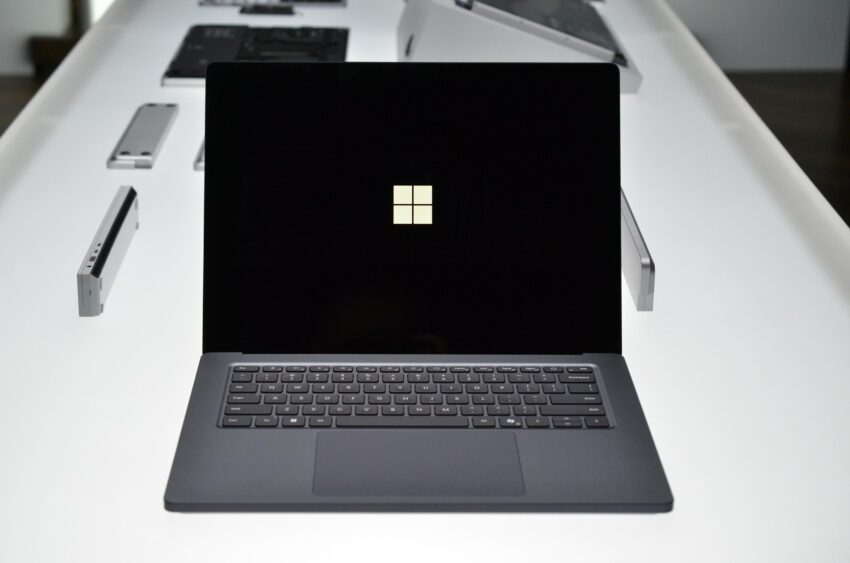
The Surface Laptop Ultra feels closer to a 16-inch MacBook Pro than to Microsoft’s more experimental Surface devices. There are no convertible hinges or detachable screens here. It is a straightforward clamshell laptop, built with performance as the priority.
Microsoft gave it a 15-inch mini LED display with up to 2,000 nits of HDR brightness. In a dark room, that peak brightness was described as extremely strong, and Microsoft says it is the brightest display it has ever shipped on a Surface device.
The laptop also introduces a larger trackpad with haptics support in Windows 11. According to the demo, the haptics can provide subtle cues when hovering near buttons or when dragging, scaling, or rotating objects. The effect is meant to make interactions feel more precise and tactile across parts of the operating system.
Tradeoffs made for battery and speed
The Surface Laptop Ultra is heavier than the 15-inch Surface Laptop 7, but Microsoft says that weight is part of the tradeoff for better performance and battery life. Andrew Hill, corporate vice president of Surface product, said the company’s design priorities were clear.
“When we went through the priority order of what we’re going to design for, performance, performance, performance, battery life, battery life, battery life, display, display, display, making sure we’d nailed those things,” Hill told The Verge. “If other tradeoffs have to be made, so be it, but let’s make sure we nail the fundamentals that are really what people care about.”
That focus showed up in Microsoft’s demos. The laptop was shown running a local AI model that used much of its 128GB of unified memory while still remaining capable of playing Indiana Jones and the Great Circle.
Cooling, repairability, and ports
Microsoft also spent attention on thermal design. The Surface Laptop Ultra has a hot spot above the keyboard and another warm area on the rear, but The Verge’s hands-on report said it was not uncomfortably hot to use on a lap. Microsoft uses two fans, which were described as barely audible even at almost full load.
Inside the machine, Microsoft has worked to make parts easier to replace. The internal layout was described as highly organized, with clearly marked components arranged in a black grid. That continues Microsoft’s push toward better repairability after the Surface Laptop 7 improved its iFixit repairability score from 0/10 in 2017 to 8/10 in 2024.
The port selection is also unusually generous for a Surface device. On the left side, the Surface Laptop Ultra has two USB-C ports and an HDMI port. On the right, it includes a USB-C port, a USB-A port, and a full-sized SD Card reader. One USB-C port on the right side appears slightly wider than the others, and Microsoft declined to explain exactly what that means for now.
Hill smiled and said Microsoft would have more to share about that port later this year. The laptop does not include Microsoft’s traditional Surface Connect magnetic charging port, which raises the possibility that the company has developed some kind of USB-C replacement.
Surface RTX Spark Dev Box: a desktop for local AI
The Surface RTX Spark Dev Box is aimed squarely at developers who want a compact but powerful PC for local work. It uses an aluminum 3D-printed body and includes 1,000 air vents in the chassis, a design choice Microsoft says ties to the device’s 1,000 teraflops of compute performance.
Visually, it resembles a flattened Xbox Series X. Microsoft equipped it with a rear I/O layout that includes two USB-C ports, USB-A, HDMI, Ethernet, and a headphone jack.
Inside, it runs the same chip as the Surface Laptop Ultra, though Microsoft says there are some minor differences it is not yet disclosing. One important difference is the thermal envelope: the Dev Box supports 100 watts, compared with up to 80 watts on the laptop. That makes it better suited to sustained workloads, especially tasks that benefit from Nvidia’s Tensor cores.
Why the Dev Box may matter
Those Tensor cores are important for AI workloads, but they also help with other features such as upscaling through Nvidia’s DLSS technology. That means the Dev Box could offer somewhat better gaming performance than the Surface Laptop Ultra, though Microsoft is clearly marketing it first as a developer machine.
The broader pitch for both products is local compute. Microsoft sees value in giving creators and developers the ability to run workloads on a machine they own rather than paying an AI cloud provider for every token. Hill framed it as a practical choice between local and cloud execution.
“What you have here is an option where you’ll be able to do a lot of work locally on a thing you own, and if you want to let it rip, cool, you’re not on a meter,” Hill said. “There are sets of workloads that run in the cloud that are better, but you’ll be able to do a lot of work here.”
Copilot Plus takes a back seat in the marketing
Even though the Surface Laptop Ultra qualifies for Microsoft’s Copilot Plus PC features, the company is not leaning heavily on that branding in its initial marketing. Instead, the messaging is centered on professionals, creators, and developers.
Hill said Microsoft is not abandoning Copilot Plus PC, but the company is choosing to emphasize the kinds of users most likely to buy this class of device. For now, that means highlighting local AI performance, premium hardware, and workstation-style capabilities rather than consumer branding.
Pricing still unknown
Microsoft has not announced pricing for either device, and that remains the biggest unanswered question. With rising costs already affecting its newer Intel-powered Surface models, these RTX Spark-based systems are likely to sit at the high end of the premium PC market.
More details are expected later this year, including the mystery around the Surface Laptop Ultra’s right-side USB-C port and the final pricing for both devices.
Source: Original report
Was this helpful?
Explore more: More Hardware & Devices Tech News Blog
Last Modified: July 7, 2026 at 9:35 pm
7 views