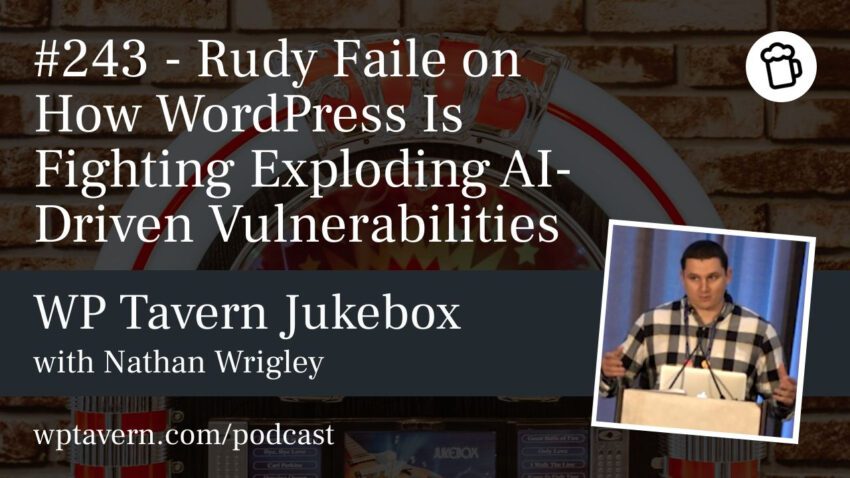
WordPress is leaning hard into security as AI accelerates the volume and sophistication of reported vulnerabilities, according to Automattic security lead Rudy Faile in a new WP Tavern podcast episode. Faile said the project has moved from handling a few dozen reports a month to hundreds, and that WordPress is now combining process changes, human review and AI-assisted triage to keep pace.
AI is changing the scale of WordPress security work
Faile said WordPress’s HackerOne program sat at roughly 20 to 30 reports a month for about a decade. In July, that number reached 450, and in August it climbed to 773. This year, he said, the project has received more than 3,000 reports, which he described as more than the previous 12 years combined.
He framed that jump as a direct consequence of AI. The issue is not only the volume of reports, but the ability of attackers to chain smaller issues into more serious ones, turning low- or medium-severity bugs into full remote code execution in ways that would previously have required much more skill and time.
Why WordPress changed its bug bounty focus
Because of that flood of reports, WordPress updated the scope of its vulnerability program on September 1. Faile said submissions that require administrator-level access are generally now out of scope unless they demonstrate real privilege escalation.
The project is instead focusing on pre-auth vulnerabilities, as well as issues that require only low-privilege access such as subscriber or customer roles on WooCommerce sites. The goal is to direct researchers toward the kinds of bugs that could realistically be exploited by attackers without legitimate site access.
The Core Security Initiative has three parts
Faile outlined the WordPress Core Security Initiative as a three-pronged effort: improve the release process, clear the backlog of reports, and use AI to help find and fix vulnerabilities before attackers do.
- A: Better release process. WordPress is reworking how releases and backports are handled, with more automation and fewer rough edges in the update pipeline.
- B: Breaking the backlog. The team is working through the influx of vulnerability reports and trying to keep the queue close to zero.
- C: Crushing vulnerabilities with AI. WordPress is using agentic systems to triage reports, reproduce issues in secure sandboxes, and help assign severity before human review.
Faile said the team still reviews every patch and report, but AI now handles much of the repetitive groundwork. That includes determining whether a report is a duplicate, whether it is applicable, and how severe it may be.
Human review still matters
Even with more automation, Faile emphasized that WordPress is not handing security over to machines. He said there is still always a human in the loop because WordPress powers too many installations to rely entirely on automated decisions.
The systems are intended to remove busy work, not judgment. In practice, that means researchers can spend less time reproducing exploits and more time making informed calls about what should be patched first.
Rethinking what counts as “high severity”
One of Faile’s central points was that AI is making old severity-based assumptions less useful. Traditionally, security teams focused on critical and high issues first, while medium and low findings were left for later. That model does not work as well when AI can chain multiple smaller flaws into something much more dangerous.
He cited wp2shell as an example of that shift. The vulnerability, which emerged last summer, chained SQL injection with another issue to become a pre-auth critical remote code execution flaw. Faile called it one of the biggest core vulnerabilities WordPress has seen in a long time.
Security is becoming a selling point
Faile suggested that security posture is likely to become more important to WordPress’s future than it has been in the past. As AI makes feature development faster for everyone, he argued, security may become one of the few areas where a platform’s depth of investment really stands out.
That could affect how WordPress core, plugin developers and theme authors market their products. In Faile’s view, being able to show that software has been scanned, reviewed and hardened may matter as much as price or feature lists.
What he thinks plugin developers should do
Faile said developers with large install bases should pay closer attention to security verification. He pointed to Anthropic’s free OSS scanner as one possible starting point for plugin authors who want an outside review of their code.
For site owners and agencies, the message is straightforward: in a world where features can be copied quickly, trust and security may be the main differentiators.
The wider internet is part of the threat model
Faile’s background in the US Navy shapes how he looks at digital risk. He said the same basic principles apply whether the asset is a ship, a server or a critical web service: assume adversaries will try to damage, disable or exploit what you are protecting.
That thinking also informs his concerns about the broader internet stack. He said lower-level flaws in protocols and networking are the most worrying because they can affect far more than one platform. WordPress, PHP and Linux all sit on top of larger layers that could create systemic problems if compromised.
Planning for disruption, not panic
Faile also used the conversation to make a practical point: people should have a basic 30-day preparedness plan for themselves and their families. He was careful to say that he is not advocating fear, just readiness.
In his view, the cost of preparing and never needing it is modest, while the cost of being caught off guard during an outage or disruption could be far higher. That same logic, he said, applies to organizations building and maintaining software.
For WordPress, the big takeaway is that AI has changed the tempo of security work. The project is responding with more automation, more process discipline and a stronger emphasis on preemptive defense, while still keeping human reviewers firmly in the loop.
Source: Original report
Was this helpful?
Explore more: WordPress Troubleshooting More WordPress & CMS Tech News
Last Modified: November 25, 2026 at 10:33 pm
3 views