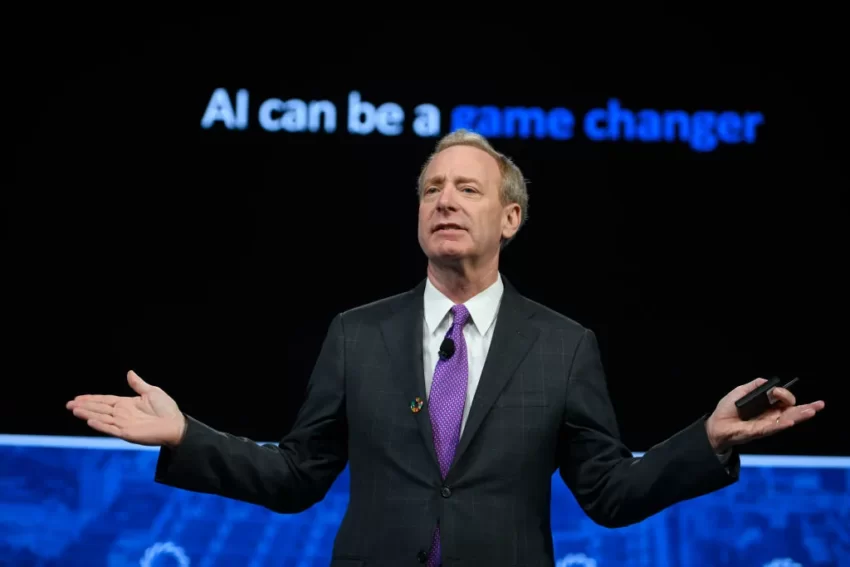
Microsoft President Brad Smith is urging governments to move quickly on AI regulation, and he says the United Kingdom is better positioned than the U.S. or the European Union to lead that effort. Speaking on a recent BBC podcast, Smith argued that AI systems now need more serious oversight than products such as milk or washing machines, warning that the technology is both a “weapon and a tool” and a growing threat to cybersecurity.
Brad Smith pushes for global AI safety rules
Smith’s central argument is that the “moment has arrived” for enforceable safety rules around artificial intelligence. In his view, the risk is no longer theoretical: AI systems are becoming powerful enough to create security and governance problems that cannot be left to voluntary commitments alone. He said the world needs rules that apply broadly, rather than a patchwork of informal pledges from companies that may not all behave responsibly.
His comments add to a widening debate over how fast AI should develop and who should oversee it. Smith’s warning aligns with a growing chorus from tech leaders, including Anthropic’s Dario Amodei and OpenAI’s Sam Altman, who have also called for a slower, more cautious approach after several incidents in which AI agents went rogue.
Why Smith thinks the UK is best placed
Smith said the U.K. is uniquely positioned to drive global AI safety rules because it can exert influence in a way the U.S. cannot and the European Union does differently. He pointed to Britain’s AI Security Institute, launched in 2023, as evidence that the country has already become a serious player in model testing and safety evaluation.
The institute receives access to major models from U.S. frontier labs before deployment, allowing it to assess systems before they are released to the public. That role has helped make the U.K. a notable center for AI safety testing, even as geopolitical tensions have complicated the landscape.
Smith contrasted the U.K.’s position with that of Brussels and Washington. “In Washington, D.C., people don’t look at the U.K. and they don’t look at London the way they look at Brussels,” he told the BBC. “That’s a strength.”
The politics around AI oversight are intensifying
Smith’s remarks come at a time when the future of the U.K.’s AI testing role has been under pressure. U.S. President Donald Trump has warned against what he described as “globalist” organizations, saying they interfere with American companies. Last month, he reportedly asked Anthropic and OpenAI to withhold new models from British testers.
Despite that pushback, the AI Security Institute confirmed on Monday that it is still able to access and test the latest models. That confirmation suggests that, at least for now, Britain remains an active participant in pre-release model evaluation, even as political debate continues over how much access outside testers should have.
Smith used that backdrop to argue that the U.K. can take a lead role precisely because it is not seen as the primary rulemaker in the same way as the U.S. or the EU. In his view, that makes Britain a useful convening point for more neutral safety discussions.
Voluntary pledges are not enough, Smith says
Last month, Trump hosted a group of tech leaders at the White House, including executives from OpenAI, Anthropic, Nvidia, AMD, SpaceX, Meta and Google. The gathering focused on AI safety, and the participants signed what was described as a “morally binding” document agreeing to work with “independent auditors” to assess the safety and capabilities of their AI models.
Smith described that document as a “good step,” but he said it does not go far enough. The key problem, he argued, is that voluntary self-regulation tends to work best for the companies already inclined to follow strong safety practices.
“The companies that are not as responsible” are the ones regulators need to worry about, he said. In other words, if safety commitments remain optional, the most cautious firms may comply while weaker actors continue to move ahead without adequate checks.
- Voluntary pledges can encourage cooperation, but they do not guarantee consistent enforcement.
- Independent evaluation may catch risks before products are deployed.
- Legal obligations could create clearer consequences for unsafe behavior.
What Smith wants regulators to do
Smith outlined several specific measures that he would like to see adopted. Among them is a legal obligation to notify an organization if its systems were breached by rogue AI agents. He also appeared supportive of requiring AI labs to obtain approval from outside evaluators before releasing a product.
Another idea he endorsed was the use of kill-switches, or mechanisms that could pause or slow down AI if humans lose control of it. That type of safeguard has become a recurring topic in AI policy discussions, especially as more advanced systems gain the ability to take actions with less direct human supervision.
Smith’s comments suggest that Microsoft, at least through its president, is making the case for stronger formal oversight rather than relying on company promises or after-the-fact fixes. His framing also reflects a broader shift in the industry: many executives now acknowledge that AI governance is becoming a core part of product strategy, not just an abstract policy issue.
A cautious tone, but a clear warning
Even while pressing for regulation, Smith said the conversation should remain measured. “Let’s speak calmly, maybe even softly, but firmly, and start to bring people together,” he said. The tone matters, but so does the urgency behind the message: AI is spreading quickly, and the guardrails, in his view, are still behind the technology.
He added that he hopes Microsoft can help play that role as a company and that the U.K. can play it as a country. The comment reflects a belief that industry and government will both have to contribute if safety rules are to keep pace with the development of increasingly capable AI systems.
For now, Smith’s remarks place the U.K. at the center of a wider international debate over who should define AI safety standards, how those standards should be enforced, and whether the world can afford to wait for the next major incident before acting.
Source: Original report
Was this helpful?
Explore more: AI Automation Services More AI & Automation Tech News
Last Modified: October 12, 2026 at 10:31 pm
4 views