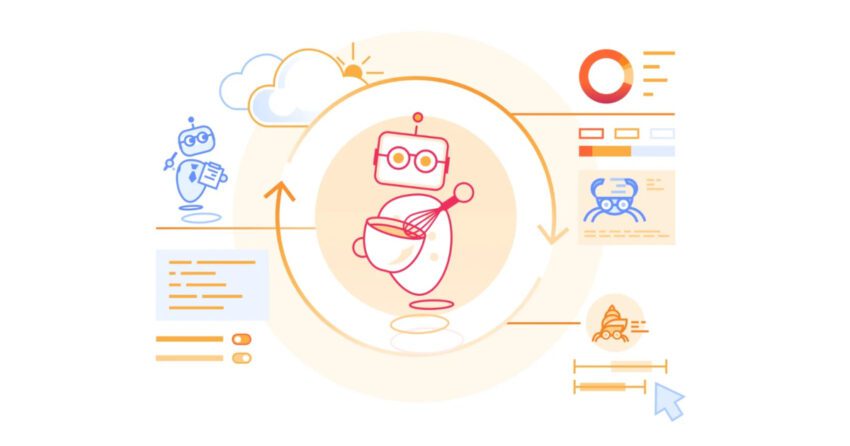
Cloudflare has unveiled the Agent Development Lifecycle, or ADLC, as a proposed successor to the traditional Software Development Lifecycle for AI-driven engineering. The company says the familiar SDLC is too linear and human-dependent for systems built around autonomous agents, and it wants to replace bottlenecked CI pipelines with an event-driven model that can support software “factories” operating at machine speed.
Cloudflare’s case for the Agent Development Lifecycle
In its announcement, Cloudflare argues that artificial intelligence already speeds up code generation, but the rest of the delivery process still relies on people moving work through review, testing, deployment, and maintenance. That creates a mismatch: code can be produced quickly, while downstream phases remain constrained by manual checks and sequential pipelines.
The company’s answer is the Agent Development Lifecycle, a model designed around software agents that can manage more of the lifecycle autonomously. Cloudflare says the aim is not simply to automate isolated tasks, but to shift from software teams to automated software factories where agents handle the full loop of building, testing, deploying, and improving applications.
Cloudflare’s view is that traditional SDLC tooling does not scale cleanly once the primary unit of work is an agent rather than a human developer. In this framing, the new lifecycle must be programmatic, horizontally scalable, and driven by events rather than by human-paced handoffs.
Why the company says traditional CI/CD is not enough
Cloudflare describes current CI/CD systems as linear workflows that work well for conventional software release processes but fall short when applied to agent-scale systems. According to the company, agent-based development needs preview environments for every agent, so multiple agents can test against production-like conditions at the same time instead of waiting for a shared staging queue.
It also says the architecture should support atomic changes and feedback loops that learn from production data. In practical terms, that means the system should be able to update, observe, and refine behavior continuously rather than depending on manual intervention after each release cycle.
Cloudflare summarized that view with a simple line in its announcement: “A CI/CD pipeline is just a Workflow. But a Workflow can be so much more than a CI/CD pipeline.”
Workflows and @cloudflare/ci at the center of the plan
To support ADLC, Cloudflare is positioning its Workflows product as the orchestration layer for agentic systems. The company says Workflows can do more than run static pipeline steps; they can dynamically spin up containers, launch headless browsers, and dispatch subagents when needed.
On top of that foundation, Cloudflare introduced @cloudflare/ci, a continuous integration and delivery system built directly on Workflows. The company says the tool lets developers chain execution steps while keeping dependency caching and credential support in place, so agents can move through tasks, handle failures, remediate bugs, and triage issues on their own.
The source material included an example workflow class showing how a nightly review process could collect findings, initialize a reviewer agent, dispatch a review request, and read the resulting response. The code sample illustrates Cloudflare’s broader point: the orchestration layer can manage a sequence of agent actions, not just a traditional build-and-test pipeline.
From pipeline mindset to orchestration mindset
That distinction matters in Cloudflare’s framing. A pipeline assumes a narrow flow of steps that mostly wait on completion, while a workflow can react to events, branch dynamically, and coordinate multiple worker-like components. For agent systems, Cloudflare says that flexibility is essential because tasks may require many tool calls, retries, and handoffs between specialized agents.
The company’s proposal also tries to formalize how these systems should be built. Rather than stitching together ad hoc scripts around an LLM, Cloudflare is advocating for a platform model with predictable orchestration primitives and a stronger operational layer around them.
Observability for agent behavior, not just infrastructure
Cloudflare says conventional telemetry is not enough for agentic software because standard application metrics may show that something happened without explaining why the agent took a certain path. To address that gap, the company launched a dedicated observability dashboard with OpenTelemetry-compatible tracing.
According to the announcement, the dashboard is designed to expose exact model calls, tool executions, and token consumption. Cloudflare says the platform integrates natively with frameworks including Think, Flue, and the AI SDK, giving engineers the ability to replay sessions, inspect subagent handoffs, and debug malformed arguments without manually combing through execution logs.
That observability layer is a key part of the ADLC pitch. If agents are going to make more decisions independently, developers will need better visibility into how those decisions were reached and how they affected the rest of the system.
Security moves from prompts to policy
Cloudflare also introduced what it calls the Agent Access Model, which is meant to secure autonomous operations. The company argues that agents operate too quickly to be managed by prompt-based guardrails alone, so security needs to be enforced at the network and harness layers instead.
Under this model, agents receive short-lived, task-bound credentials with a limited capability ceiling. Cloudflare says a Trust Ratchet mechanism can reduce those capabilities further once an agent touches protected resources, helping enforce least-privilege execution and limiting lateral movement if the agent encounters malicious input.
The security framing is important because agentic systems can chain together many tool calls in a short time. Cloudflare’s model is meant to keep those systems from gaining broader access than they need for a specific task.
What Cloudflare is trying to standardize
- Event-driven orchestration through Workflows rather than static pipeline steps.
- Agent-aware CI/CD with @cloudflare/ci running on top of Workflows.
- OpenTelemetry-compatible tracing for model calls, tool use, and token consumption.
- Task-bound credentials and capability limits through the Agent Access Model.
- Trust Ratchet controls that reduce permissions after access to protected resources.
A broader signal about where development may be heading
Cloudflare says the goal of ADLC is to provide the infrastructure agents need to operate securely across the software factory ecosystem. The company presents the work as an early iteration, but one that points toward a more dynamic model where artificial intelligence handles more of the application lifecycle from start to finish.
The announcement lands at a moment when many teams are experimenting with AI coding assistants, automated testing, and agent-based tooling, but are still using release processes built for human developers. Cloudflare’s view is that the underlying lifecycle itself needs to change if autonomous systems are going to become first-class participants in software delivery.
Whether the industry embraces ADLC as a replacement for SDLC remains to be seen, but Cloudflare’s announcement makes its direction clear: it wants to move agentic software from experimental add-on to core platform architecture, with orchestration, observability, and security designed around autonomy rather than adapted from older DevOps patterns.
Source: Original report
Was this helpful?
Explore more: AI Automation Services More AI & Automation Tech News
Last Modified: September 21, 2026 at 10:33 pm
0 views