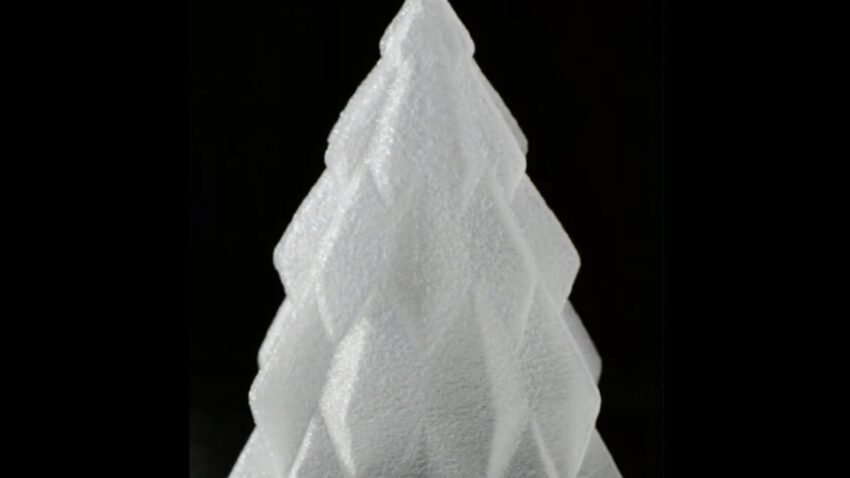
physicists 3d-printed a christmas tree of ice Researchers at the University of Amsterdam have successfully created a unique holiday decoration: a miniature Christmas tree made entirely of ice, measuring just 8 centimeters tall, using an innovative 3D-printing technique that requires no refrigeration or advanced freezing technology.
physicists 3d-printed a christmas tree of ice
Innovative Use of Evaporative Cooling
The breakthrough, detailed in a preprint posted to the physics repository arXiv, leverages the principle of evaporative cooling, a phenomenon that is not only familiar in everyday life but also plays a significant role in various scientific applications. Evaporative cooling occurs when liquid evaporates, absorbing heat from its surroundings and thereby lowering the temperature of the remaining liquid. This principle is utilized by mammals to regulate body temperature, as well as in various industrial processes.
Understanding Evaporative Cooling
Evaporative cooling is a natural process that can be observed in many contexts. For instance, when you pour a hot cup of coffee, the hotter molecules at the surface gain enough energy to escape into the air as steam. This loss of higher-energy molecules results in a decrease in temperature for the remaining liquid. Similarly, the formation of “wine tears” or “legs” in a glass of wine is influenced by evaporative cooling, where the evaporation of alcohol creates a gradient that affects the liquid’s surface tension.
In the context of the 3D-printed ice Christmas tree, the researchers utilized this principle to create a structure that can maintain its form without the need for constant refrigeration. This is particularly significant given the challenges associated with working with ice, which typically requires controlled environments to prevent melting.
Applications Beyond Holiday Decor
The implications of this research extend beyond festive decorations. The ability to create ice structures using evaporative cooling could have various applications in fields such as architecture, art, and even food presentation. For example, chefs and event planners might find innovative ways to incorporate ice sculptures into their designs, enhancing the aesthetic appeal of their presentations while minimizing the need for bulky refrigeration equipment.
The Science Behind 3D Printing Ice
The process of 3D printing ice involves several intricate steps that require a deep understanding of both material science and thermodynamics. The researchers at the University of Amsterdam developed a method that allows them to manipulate water at a molecular level, enabling the creation of complex shapes and structures.
Materials and Techniques
To create the ice Christmas tree, the researchers began by designing a digital model of the tree using computer-aided design (CAD) software. This model was then translated into a format suitable for 3D printing. The printing process involves layering water in a controlled environment where evaporative cooling can occur effectively. As each layer is printed, the water begins to freeze, allowing the structure to take shape.
One of the key challenges in this process is managing the temperature and humidity levels to ensure that the ice does not melt or deform during the printing process. The researchers employed various techniques to optimize these conditions, including adjusting the ambient temperature and controlling the airflow around the printed structure. This meticulous attention to detail is what allows the ice tree to maintain its integrity without the need for refrigeration.
Challenges and Limitations
While the creation of a 3D-printed ice Christmas tree is an impressive feat, it is not without its challenges. The primary concern is the stability of the ice structure over time. Ice is inherently fragile and can be prone to melting, especially in warmer environments. The researchers are aware that the longevity of such creations is limited, and they are exploring ways to enhance the durability of the ice structures.
Additionally, the scalability of this technology remains a topic of discussion. While creating a small ice sculpture is feasible, producing larger structures may require further advancements in technology and techniques. The researchers are optimistic that with continued experimentation, they can overcome these hurdles and expand the possibilities of 3D-printed ice.
Broader Implications for Science and Industry
The development of 3D-printed ice structures opens up a myriad of possibilities in various fields. The principles of evaporative cooling and ice printing could be applied in several innovative ways, potentially transforming industries ranging from food service to construction.
Food Industry Innovations
In the food industry, the ability to create intricate ice sculptures could enhance catering and event experiences. Chefs could use 3D-printed ice to create unique serving vessels or decorative elements that not only look stunning but also serve functional purposes, such as keeping food and beverages chilled. This could lead to a new trend in culinary presentations, where the aesthetics of ice sculptures are combined with their practical benefits.
Architectural Applications
In architecture, the principles behind 3D-printed ice could inspire new designs and materials. The concept of using ice as a building material may seem unconventional, but it could lead to innovative temporary structures or installations that capture the imagination. For instance, ice could be used in art installations or seasonal attractions, drawing visitors and creating unique experiences.
Environmental Considerations
From an environmental standpoint, the use of evaporative cooling and ice printing could contribute to sustainability efforts. Traditional refrigeration methods consume significant energy and contribute to greenhouse gas emissions. By utilizing natural processes like evaporative cooling, researchers and industries could reduce their carbon footprint and promote more sustainable practices.
Reactions from the Scientific Community
The scientific community has responded positively to the research conducted by the University of Amsterdam. Experts in the fields of physics and material science have expressed interest in the potential applications of 3D-printed ice and the innovative use of evaporative cooling. Many see this as a promising avenue for further exploration and experimentation.
Some researchers have highlighted the importance of interdisciplinary collaboration in advancing this field. The intersection of physics, engineering, and art could lead to groundbreaking discoveries and applications that benefit society as a whole. As more scientists and engineers engage with this technology, the possibilities for innovation will continue to expand.
Future Directions
Looking ahead, the researchers at the University of Amsterdam are eager to continue their work in this area. They plan to explore new designs and applications for 3D-printed ice, as well as investigate ways to enhance the durability and stability of ice structures. Additionally, they are interested in collaborating with artists and chefs to push the boundaries of what is possible with this technology.
As interest in 3D printing and sustainable practices grows, the potential for 3D-printed ice to become a mainstream application in various industries is becoming increasingly plausible. The combination of creativity, science, and technology could lead to exciting developments that capture the spirit of innovation during the holiday season and beyond.
Was this helpful?
Last Modified: December 18, 2025 at 9:37 am
3 views