openai s chatgpt translator challenges google translate OpenAI has introduced ChatGPT Translate, a new web-based translation tool that aims to compete directly with Google Translate.
openai s chatgpt translator challenges google translate
Overview of ChatGPT Translate
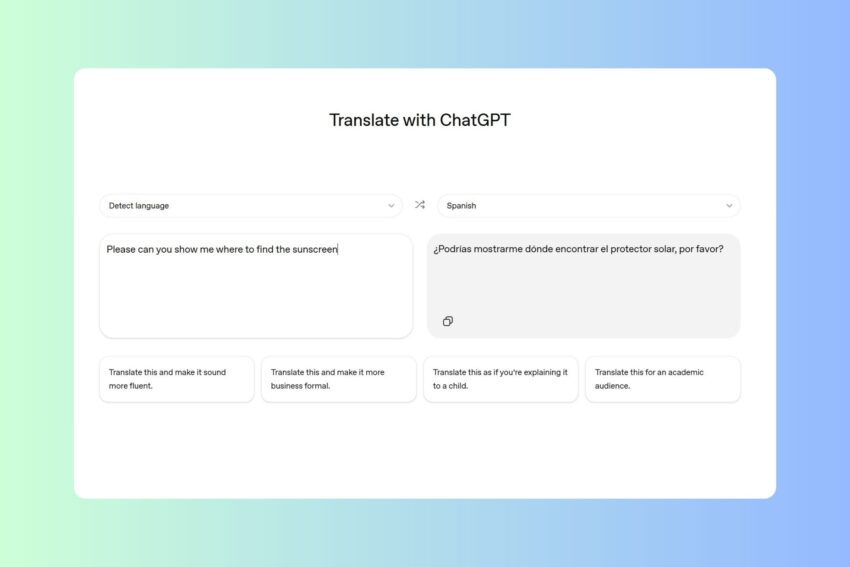
ChatGPT Translate is a standalone translation tool that supports over 50 languages, making it a formidable player in the translation market. The interface will be familiar to users of Google Translate, featuring two text boxes—one for inputting the source text and another for displaying the translated output. Additionally, dropdown menus allow users to select the languages they wish to translate from and to.
Key Features
While the visual layout of ChatGPT Translate may resemble that of Google Translate, several key features set it apart:
- Language Support: ChatGPT Translate supports a wide array of languages, exceeding 50, which allows for versatile use across different linguistic contexts.
- Style Presets: Unlike Google Translate, ChatGPT Translate includes style presets that enable users to adjust the tone and formality of the translation, offering a more tailored experience.
- Contextual Understanding: Leveraging the capabilities of OpenAI’s language model, ChatGPT Translate aims to provide more nuanced translations that consider context, idioms, and cultural references.
Comparison with Google Translate
Google Translate has long been the dominant player in the translation space, offering a robust set of features that cater to a wide range of user needs. Here are some of the notable functionalities that Google Translate provides:
- Document and Image Translation: Users can upload images, documents, and even entire websites for translation, which is a feature that ChatGPT Translate currently lacks.
- Real-Time Translation: Google Translate offers real-time translation capabilities, including voice input and live camera translation, which allows users to translate text on-the-go.
- Extensive Language Database: Google Translate supports over 100 languages, providing a broader selection compared to ChatGPT Translate.
Despite these advantages, ChatGPT Translate aims to carve out its niche by focusing on quality and user experience. The tool’s emphasis on contextual understanding and style presets may appeal to users who require more than just a literal translation.
Technological Underpinnings
OpenAI’s ChatGPT Translate is built on advanced machine learning algorithms that analyze and generate human-like text. This technology allows the tool to understand not just the words being translated but also the context in which they are used. This capability is particularly important for languages that rely heavily on idiomatic expressions or cultural nuances.
OpenAI’s models have been trained on a diverse range of texts, enabling them to capture various linguistic styles and tones. This training allows ChatGPT Translate to offer translations that are not only accurate but also contextually appropriate.
Implications for Users
The launch of ChatGPT Translate presents several implications for users:
- Enhanced User Experience: With the addition of style presets, users can expect translations that better match their intended tone, whether formal, casual, or technical.
- Increased Competition: The introduction of ChatGPT Translate may push Google Translate to innovate further, potentially leading to improvements in both platforms.
- Accessibility: As a web-based tool, ChatGPT Translate is easily accessible to anyone with an internet connection, making it a convenient option for casual users and professionals alike.
Stakeholder Reactions
The launch of ChatGPT Translate has garnered attention from various stakeholders, including users, industry experts, and competitors. Early user feedback has highlighted the tool’s ease of use and the quality of translations, particularly in complex linguistic scenarios.
Industry experts have noted that OpenAI’s entry into the translation space could signal a shift in how translation tools are developed and utilized. The focus on contextual understanding and user experience may set new standards for translation services.
Challenges Ahead
Despite its promising features, ChatGPT Translate faces several challenges:
- Market Penetration: Google Translate has established a strong foothold in the market, and gaining user trust will require significant effort from OpenAI.
- Feature Gaps: The absence of features like document and image translation may limit ChatGPT Translate’s appeal to users who require a comprehensive translation solution.
- Continuous Improvement: OpenAI will need to continuously update and improve the tool to keep pace with user expectations and technological advancements.
Future Developments
As OpenAI continues to refine ChatGPT Translate, several potential developments could enhance its functionality:
- Integration with Other Tools: Future iterations may see ChatGPT Translate integrated with other OpenAI products, allowing for a more seamless user experience.
- Mobile Application: The development of a mobile app could expand accessibility, enabling users to translate text on-the-go.
- Community Feedback: OpenAI may implement a feedback mechanism that allows users to suggest improvements or report inaccuracies, fostering a community-driven approach to development.
Conclusion
OpenAI’s ChatGPT Translate represents a significant advancement in the field of language translation, offering a fresh alternative to established services like Google Translate. With its focus on contextual understanding and user experience, it has the potential to meet the needs of a diverse range of users. However, challenges remain, and the tool must continue to evolve to compete effectively in a crowded market. As the landscape of translation technology continues to change, ChatGPT Translate could play a pivotal role in shaping the future of how we communicate across languages.
Source: Original report
Was this helpful?
Last Modified: January 15, 2026 at 7:44 pm
1 views