new youtube ai tools help creators give YouTube has unveiled new AI tools designed to assist creators in optimizing their content and engaging more effectively with their audiences.
new youtube ai tools help creators give
Introduction of AI Features at Made on YouTube Event
At the recent Made on YouTube event held in New York, the platform introduced a suite of innovative AI features aimed at content creators. These tools are designed to streamline the often labor-intensive behind-the-scenes work that goes into producing videos. Unlike previous offerings that focused on creative elements such as background music or visual content generation, the new features are largely centered around content strategy. They are marketed as solutions to help creators reach new audiences while also enhancing their connection with existing viewers.
Ask Studio: A New AI Chatbot for Creators
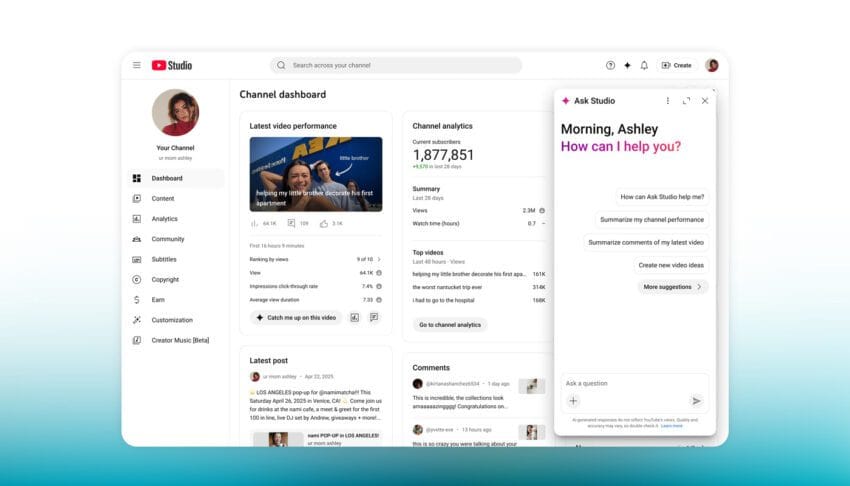
One of the standout tools launched is Ask Studio, an AI chatbot that provides creators with analytics insights regarding their content performance. Amjad Hanif, YouTube’s Vice President of Product Management, describes Ask Studio as a “creative partner.” This tool enables creators to inquire about various aspects of their videos, such as audience engagement and the most compelling moments. By aggregating data from a creator’s entire YouTube channel, including long-form videos and Shorts, Ask Studio serves as a faster and more direct analytics tool integrated into the platform.
Functionality of Ask Studio
Creators can utilize Ask Studio to perform a variety of tasks, including:
- Summarizing viewer comments to gauge sentiment.
- Providing suggestions for optimizing content based on viewer drop-off points.
- Generating video ideas derived from comments on recent uploads.
- Offering title suggestions to improve click-through rates.
However, it is important to note that Ask Studio currently lacks the capability to compare performance metrics across different channels. For instance, creators cannot ask the tool which videos from competitors are performing well, which could limit its utility for those looking to benchmark their performance against others.
A/B Testing for Thumbnails and Titles
Another significant feature being rolled out is an enhanced A/B testing tool for thumbnails and titles. This builds upon a thumbnail testing feature introduced last year. With the new update, creators can pair different thumbnail images with titles and run tests to determine which combination yields the highest watch time. The “winning” combination is identified based on viewer engagement metrics.
Importance of Thumbnails and Titles
Ashley Alexander, a lifestyle influencer who had early access to these tools, emphasizes the critical role that thumbnails and titles play in attracting viewers. “No matter how good the video is, the thumbnail and title is what gets people to even see the video and see if it’s good or not. It might be the most important thing, honestly,” she states. Alexander has integrated the thumbnail-only testing feature into her workflow and is now utilizing the new A/B testing tool for every video she produces.
The Shift in Content Creation Strategy
The introduction of these tools signifies a paradigm shift in how creators approach content optimization. Historically, creators relied on trial and error to determine what resonated with their audience. They experimented with enticing titles, thumbnail designs, and content formats, often without any guidance from the platforms themselves. However, with the advent of AI-driven tools, platforms like YouTube are now providing direct recommendations on what creators should produce.
Impact of AI on Content Strategy
This shift in strategy is not unique to YouTube. Other platforms, such as TikTok, have also begun to offer explicit guidance to creators, informing them about trending topics and user searches. This dual approach benefits both creators and the platforms: creators gain insights into what content is likely to engage viewers, while platforms like YouTube can ensure that users spend more time on their site, watching videos. The ultimate goal is to create a win-win scenario where both parties thrive.
Expanding Viewer-Facing AI Tools
YouTube is also enhancing its viewer-facing AI tools, such as the auto-dubbing feature. Previously, creators could use this feature to add dubbed audio to their videos, but the latest update allows for lip-syncing to match the dubbed language. This enhancement aims to improve the viewer experience by making dubbed content feel more natural. Videos that utilize this AI dubbing feature will carry a badge indicating that they were auto-dubbed, providing transparency to viewers.
Collaborative Features for Creators
In addition to these AI tools, YouTube is introducing a cross-posting feature that allows multiple collaborators to work on a single video. Each collaborator will have access to performance metrics, enabling them to analyze how the video is performing collectively. This feature is particularly beneficial for creators who often collaborate with others, as it allows for a more streamlined approach to content creation and performance evaluation.
The Broader Context of AI in Content Creation
The integration of AI into content creation is not a new phenomenon; it has been gradually permeating various industries. For instance, adult content creators have started using chatbots to interact with paying clients, while advertisers are encouraged to utilize AI-generated models for marketing purposes. Recently, YouTube updated its monetization rules, leading many creators to speculate that the “inauthentic content” policy was aimed at AI-generated, mass-produced videos. This has raised concerns about how YouTube will define and screen “inauthentic” content and what criteria will be used for demonetization.
Concerns About Authenticity and Viewer Engagement
As AI tools become more prevalent, questions arise about their impact on authenticity in content creation. Will viewers care if their favorite YouTuber relies on AI to generate video ideas? If all creators utilize the same built-in tools to optimize their content, does that dilute the uniqueness of individual creators? These questions highlight the tension between leveraging technology for efficiency and maintaining the personal touch that audiences often seek.
Creators’ Perspectives on AI Tools
Despite the potential challenges, creators like Ashley Alexander view these AI features as valuable starting points rather than shortcuts. “The AI-generated ideas are a good place to start, but ultimately I know my audience best,” she asserts. For many creators, their relationship with their audience is built on trust and authenticity, which AI cannot replicate. While AI tools can provide data-driven insights, the creative choices made by individual creators remain crucial in maintaining that connection.
The Future of AI in Content Creation
As YouTube and other platforms continue to evolve, the role of AI in content creation will likely expand. While these tools can enhance efficiency and provide valuable insights, the challenge will be to strike a balance between leveraging technology and preserving the authenticity that audiences value. The future of content creation may involve a hybrid approach, where creators use AI as a supportive tool while still infusing their unique perspectives and creativity into their work.
In conclusion, the introduction of AI tools like Ask Studio and enhanced A/B testing features marks a significant development for YouTube creators. These innovations aim to optimize content strategy and improve audience engagement, but they also raise important questions about authenticity and the evolving landscape of content creation. As creators navigate this new terrain, their ability to maintain a genuine connection with their audiences will be paramount.
Source: Original report
Was this helpful?
Last Modified: September 16, 2025 at 9:38 pm
1 views