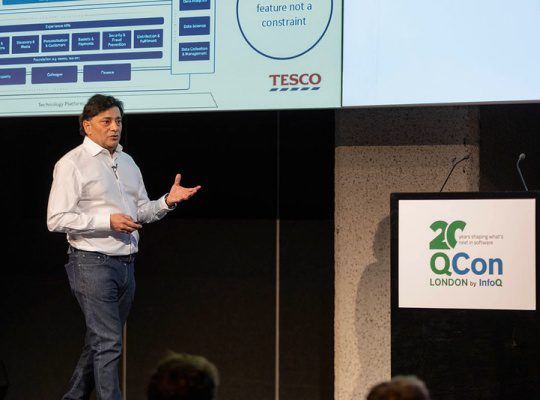
At QCon London 2026, Tesco Senior Engineering Director Jayesh Bhayani outlined a decade-long transformation that took the retailer from fragmented legacy systems to a unified cloud-edge platform. His presentation, Modernising Retail at Scale: Architecting a Cloud‑to‑Edge Platform for a Global Enterprise, focused on how Tesco aligned systems, talent and processes to support mission-critical retail operations for millions of customers while preparing for the next wave of agentic commerce.
Why Tesco had to change
Bhayani described the starting point as a highly siloed technology landscape shaped by historical business structures. Tesco’s online grocery, marketplace, clothing and wine operations each ran on different stacks, with no single customer identity and no common view of stock or pricing. In his account, even basic customer continuity was missing: separate logins existed for different business lines, and there was no unified data platform to connect them.
The operational footprint made the problem larger than a typical enterprise refactor. Tesco has around 5,000 stores across five countries, 20 distribution centers, 25 million customers, 350,000 colleagues, 50 million baskets, 1.3 million online orders a week and 4.5 billion calls a day. It also supports around 50,000 tills, plus many more handheld devices and connected systems across the estate.
That scale became especially visible during COVID, when Tesco had to double the number of online slots available to customers. Bhayani said that effort was equivalent to putting almost three other competitor companies online in one month. For a business with low margins, that kind of growth pressure meant technology could not remain a back-office utility.
Moving from silos to a retail platform
According to Bhayani, Tesco’s core challenge was not only technical but structural. The company needed omnichannel capability, faster change cycles, more reliability, better security and a coherent experience across physical and digital channels. The answer was a shift from fragmented stacks to a unified retail platform that could serve multiple channels and markets while supporting multi-tenancy.
The transformation was not treated as a single technology project. Bhayani framed it as a three-part effort: system transformation, talent transformation and process transformation. In his view, changing the platform without changing the organization and delivery model would simply recreate the same problems in a new form.
- System transformation: replacing fragmented stacks with a unified platform architecture.
- Talent transformation: moving from outsourced delivery to stronger in-house engineering and product capabilities.
- Process transformation: shifting from program-led delivery to an agile, product-driven model.
Build and buy, not build versus buy
One of the earliest strategic decisions was how Tesco would balance internal development with purchased technology. Bhayani said the company adopted a “build and buy” approach: build what differentiates Tesco in the market, and buy what does not. That meant homegrown investment in the retail platform and POS capabilities, while buying many back-office systems such as finance and people tools.
He emphasized that integration matters even when a capability is bought. For Tesco, the core platform spans tills, handheld scan-as-you-shop devices, cameras and other store systems. The goal was not just to own software, but to ensure all those components worked as part of a single operating model.
Cloud, private cloud and edge working together
Bhayani said Tesco’s architecture now spans private cloud, public cloud and edge devices. Public cloud is used where the business needs elasticity and scale, while private cloud remains important for many supply chain and distribution workloads. He said around 80% of Tesco’s presence is in private cloud, while 20% is in public cloud, but that the cost profile is the reverse: roughly 80% of cloud spend lands in public cloud.
He warned that public cloud can create long-term lock-in if teams rely too heavily on proprietary platform services. Tesco’s preference, he said, is to use portable PaaS technologies where possible so the company keeps flexibility. In his telling, the retailer learned this the hard way: early enthusiasm for public cloud led to rapid adoption, limited value visibility and later repatriation of some workloads.
The edge layer is just as important. Tesco stores need to keep operating even when networks are unreliable, so the same core platform services are designed to run in both cloud and edge environments. That includes business logic for identity, loyalty, pricing, payments and shelf-edge updates. Bhayani said the platform is designed to fail in favor of the customer when connectivity drops.
What the platform had to solve
Bhayani grouped Tesco’s platform principles around resilience, reuse and operational realism. The architecture had to support offline operations, security, data quality, composable services and multi-tenancy by default. It also had to account for the real economics of grocery, where every penny matters.
He noted that an action as simple as adding an item to a shopping cart can involve around 40 microservices, from identity and product lookup to pricing and personalization. At that level, abstractions are not just a convenience; they are required to keep systems usable and fast.
Tesco also made a deliberate choice to have the same team own the retail platform in the cloud and at the edge. Bhayani argued that separating legacy and modern systems into different teams creates a motivation and accountability problem. One team owning the end-to-end platform, he said, helped keep consistency and responsibility intact.
Preparing for agentic commerce
Looking ahead, Bhayani said Tesco is preparing for agentic commerce, which he described as a business decision as much as a technology one. If customers increasingly use assistants such as ChatGPT or Gemini to shop on their behalf, retailers that do not adapt risk being marginalized. But participating in that ecosystem also means giving up some of the direct customer experience.
He said the platform must evolve from a system of record into a system of delegation. That requires machine-readable data, identity and consent controls, policy frameworks and support for emerging protocols such as UCP, ACP and MCP. At Tesco’s scale, he cautioned, those technologies are not yet ready for production in every respect, and regulations also vary by country.
The same retail platform, he said, will still underpin those future experiences. Existing application gateways and APIs will continue to serve stores and online channels, while new agent-facing gateways will manage what external agents can see and do.
Lessons from a decade of transformation
Bhayani closed with several lessons for large enterprises considering similar change. First, build a central tech platform early, rather than allowing every team to create its own pipelines, observability stack and tooling. Second, manage the portfolio deliberately, because scale demands clear investment decisions. Third, align location strategy and team structure so product, engineering and program work can operate as self-sufficient units.
He also stressed that transformation is a long game. Throughput rises only after foundational capabilities are in place, and technology leaders need to explain value early instead of building “tech for tech.” Vendor lock-in, IP leakage and cost discipline remain ongoing concerns, especially as new waves such as agentic development accelerate the pace of change.
For Tesco, the broader lesson was cultural: technology, talent and process must move together. Bhayani’s message was that large-scale modernization is not a one-time migration, but an operating model that keeps adapting as the business, and the wider retail landscape, changes.
Source: Original report
Was this helpful?
Explore more: DevOps Services More Cloud & DevOps Tech News
Last Modified: November 22, 2026 at 10:32 pm
0 views