Google has open-sourced AQuA, short for Ambient Quality Agent, a reference implementation designed to diagnose production AI agent failures that can slip past conventional monitoring. Rather than watching the request path directly, AQuA analyzes agent sessions in the background, looks for recurring quality regressions, and ties likely causes back to deployed source revisions.
What AQuA is meant to catch
Google says the tool is aimed at “silent” failures that can be hard to spot when an agent still returns a successful response. Examples include an assistant ignoring user preferences, skipping required tool calls, or otherwise drifting from expected behavior without triggering an obvious infrastructure alert.
That focus matters because agent systems can appear healthy at the platform level while still producing poor outcomes for users. AQuA is positioned as a quality layer, not just an uptime tool, giving teams a way to inspect whether a production agent is behaving as intended.
How Google says Ambient Quality Agent works
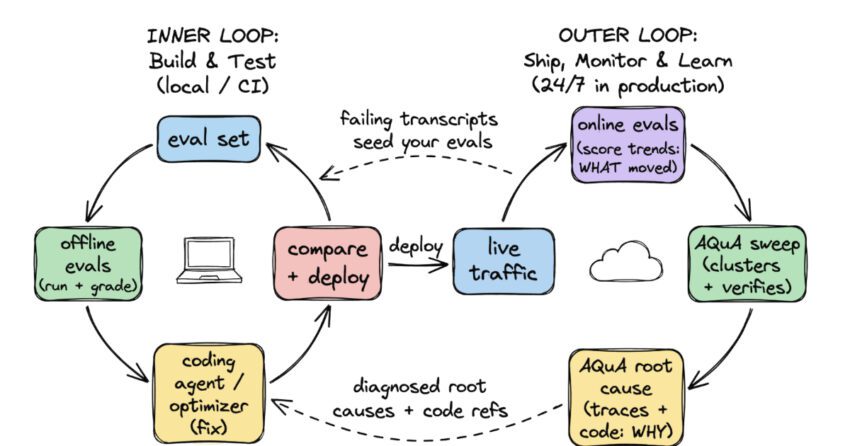
AQuA runs alongside an agent in Google Cloud, outside the request path. It reads telemetry from Cloud Trace, Cloud Logging, or BigQuery, then processes recent sessions through five stages: sampling, reviewing, clustering findings, verifying candidate clusters, and tracking issues.
The implementation can sample up to 1,000 recent sessions per run. Developers can also define domain-specific quality criteria in a goal.md file and add deterministic custom metrics, which lets teams adapt the system to their own success conditions.
Google says AQuA can be run on a schedule, after a deployment, or on demand. That makes it usable both as a continuous quality check and as a post-release diagnosis tool when teams suspect a regression.
Root cause analysis tied to deployed code
For diagnosis, AQuA compares failing sessions with an immutable source snapshot captured at deployment. Its diagnosis agent identifies relevant code or instructions, cites file and line ranges, and proposes changes when the problem appears to come from the repository.
The system can also attribute failures to external dependencies, tool handoffs, or retrieved data. Google says AQuA does not automatically apply fixes or open pull requests, which keeps the tool in the analysis role rather than making code changes on its own.
Google’s example results from a travel app
In one evaluation, Google analyzed 32 sessions from a multi-agent travel application. The system surfaced 42 findings that were grouped into nine candidate clusters, and the verifier rejected three unsupported clusters after checking up to three full transcripts per candidate cluster.
That left six verified issues. Two of them involved bypassing seat availability checks and losing a traveler’s vegan preference during delegation.
Google then modified prompts and replayed the sessions. In that controlled replay, seat-selection bypasses dropped from 15 sessions to two, dietary-preference omissions fell from seven to zero, and the number of sessions passing all checks rose from five to 13.
Those results came from replay rather than live production traffic, so they show the tool’s potential under controlled conditions rather than proof of real-world behavior at scale.
Why the design matters for production AI agents
Google’s approach reflects a growing concern in agentic systems: the hardest failures are not always crashes, but subtle behavior regressions. A system can look healthy in logs and metrics while still making bad decisions, skipping steps, or ignoring user context.
AQuA’s clustering and verification stages are intended to reduce noise before teams spend time investigating. The company says findings are linked to supporting traces, and proposed root causes must reference valid lines in the deployed snapshot.
- Findings are categorized as NEW, RECURRING, or automatically RESOLVED after 14 days without being observed.
- Sampling can miss rare failures, so the system is not a guarantee of complete coverage.
- Replay may not reproduce external state, which can limit how confidently some issues can be verified.
Comparison with other agent observability tools
Google frames AQuA as distinct from tools focused on regression testing or general tracing. The company points to its Agent Platform evaluation service for regression testing and production quality monitoring, while Arize Phoenix offers open-source tracing and evaluation.
AQuA’s narrower role is to group production failures and connect verified findings to deployed source code. In other words, it is designed less as a broad observability stack and more as a diagnosis layer for recurring, production-visible agent quality issues.
What the open source release signals
The open-source release gives teams a reference implementation they can adapt to their own agent workflows. It also suggests Google is treating production AI quality as a distinct engineering problem, not just an extension of standard observability.
Reacting to the announcement on LinkedIn, Dmytro Aprelenko, engineering manager at Redcore, wrote: “Agent orchestration definitely needs better continuous diagnosis to catch these loops early.”
Google’s published constraints are part of the story too. The company acknowledges that sampling can miss rare failures and that replay cannot always capture the external state that influenced the original session. Even so, AQuA offers a structured way to move from vague quality complaints to traceable, source-linked findings.
Source: Original report
Was this helpful?
Explore more: AI Automation Services More AI & Automation Tech News
Last Modified: November 13, 2026 at 10:33 pm
3 views