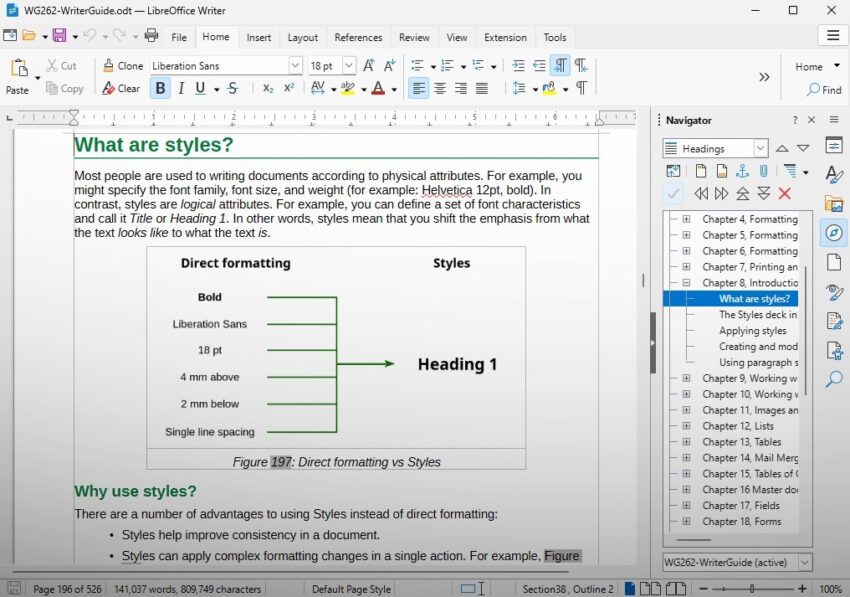
If you want a document editor that steers clear of artificial intelligence, LibreOffice is now making that stance part of its identity. The open source office suite’s creator, The Document Foundation, says it will not add AI to LibreOffice for the foreseeable future, framing the absence of AI as a deliberate software feature rather than a missing capability.
LibreOffice turns “no AI” into a product choice
The Document Foundation, the nonprofit behind LibreOffice, laid out its position in a blog post this week. The organization said it does not reject AI in principle, but it “will not add” it to LibreOffice for now.
That statement follows the release of the latest LibreOffice version in late August, when the nonprofit emphasized that the software “contains no generative AI features.” At the time, the foundation described that absence as a “deliberate design position” intended to protect user privacy and keep the application fully usable without network access.
The message is straightforward: LibreOffice wants to remain a local, offline-first tool, not a cloud-connected assistant that depends on sending documents to remote systems for processing.
Why LibreOffice is drawing a line
The nonprofit’s argument centers on user control. LibreOffice said its software is used by tens of millions of people and organizations, and that those users should be able to keep control of their data rather than trust a remote service with sensitive documents.
In the foundation’s view, the privacy question is especially important for workplaces handling confidential, legally privileged, or personal information. The organization said such users need to know where their data goes, adding that “the only assurance that survives an audit is that it does not leave the machine.”
That emphasis on local processing also reflects a broader technical principle: LibreOffice does not require a network connection to function. For many users, that is part of the appeal. The suite can run without cloud dependencies, account logins, or continuous internet access, which is increasingly rare in mainstream productivity software.
Extensions remain an option
LibreOffice is not banning AI entirely from its ecosystem. Instead, it says users who want AI tools can add them through software extensions, including ones that connect to local AI models.
That distinction matters. Rather than bundling AI into the default installation, the project is keeping the core product free of those features while leaving room for optional add-ons for people who actively want them. In practical terms, the software can stay lightweight and predictable for users who prefer it that way.
The foundation said there is currently “no integration” that meets all of its requirements. Those requirements include ensuring that user data stays on the device and avoiding reliance on a single AI provider.
A contrast with the rest of the software industry
LibreOffice’s decision runs against the current direction of much of the software market, where companies are adding AI features to apps of every kind. Word processors, email clients, browsers, note-taking tools and operating systems are increasingly being redesigned to include chatbots, writing helpers, summarization tools and automated assistants.
For some users, those additions are helpful. For others, they are another layer of complexity that can make software slower, noisier and harder to trust. That frustration has become common enough that developers have started building tools and browser extensions designed to block, strip out or disable AI features altogether.
The source material also points to a wider critique sometimes described as “enshittification,” a term used to describe the gradual decline of product quality as companies pack in more features, often at the expense of usability. LibreOffice’s position fits neatly into that backlash: instead of treating AI as inevitable, it is presenting restraint as a benefit.
What the project is actually saying
LibreOffice’s announcement is not a declaration that AI has no value. The organization explicitly said its position is not a “definitive rejection” of the technology and should be understood as an assessment of the current state of the market.
In other words, the project is saying that today’s AI products do not meet its standards for privacy, independence and local control. It also said it will “closely monitor where the technology is actually heading,” leaving the door open if the ecosystem changes in ways that align with its requirements.
Until then, the default experience will stay simple: no AI of any kind in the base installation. That includes no generative writing tools, no remote assistant features and no hidden background reliance on outside services.
Why this matters for open source users
LibreOffice has long been one of the main alternatives for people and organizations that want an office suite outside the orbit of large commercial vendors. Its open source roots and offline operation appeal to schools, governments, businesses and individuals looking for more control over their software stack.
That positioning may become even more relevant as AI becomes a standard feature in commercial productivity suites. By refusing to make AI part of its default package, LibreOffice is effectively offering a different bargain: fewer automated conveniences, but also fewer privacy trade-offs and less dependence on external infrastructure.
For users who simply want to open, edit and save documents without handing them to a server, that can be the feature that matters most.
The bigger software trend behind the announcement
LibreOffice’s stance also reflects a growing split in how software is being designed. One path assumes AI should be embedded everywhere by default. The other prioritizes user control, local execution and a smaller, more predictable feature set.
As more applications add AI to the center of their interface, some people are actively seeking software that does the opposite. In that context, LibreOffice’s “no AI” message is not just a technical choice. It is also a statement about what kind of product the project wants to remain.
For now, the answer is clear: LibreOffice would rather be known for not adding AI than for racing to include it.
Source: Original report
Was this helpful?
Explore more: Software Development More Software Development Tech News
Last Modified: October 6, 2026 at 10:32 pm
0 views