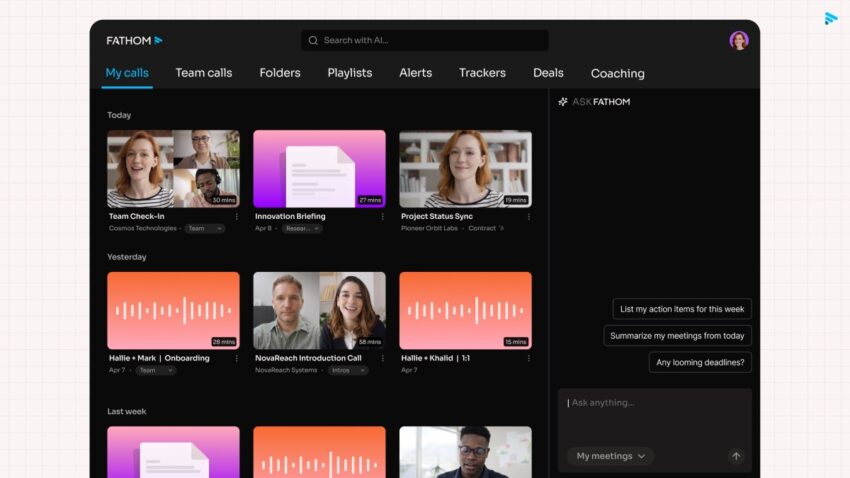
Superhuman is adding a meeting notetaker to its productivity stack, but instead of building one from scratch, the company is acquiring Y Combinator-backed Fathom. The deal reflects a broader shift in productivity software, where companies are racing to turn meeting notes into the raw material for more proactive, agentic AI work.
Superhuman’s bet on meeting context
AI productivity tools have mostly focused on user-triggered automation: a person types a prompt, an app generates a workflow, and work gets moving. Superhuman’s view is that the next step is for AI to begin acting on its own, and meeting content is one of the richest places to find what should happen next.
That is why notetaking has become strategically important. Meetings often contain decisions, action items, deadlines, and follow-ups that can be turned into emails, calendar events, database updates, or agent-driven tasks. With Fathom in the middle of its platform, Superhuman expects to surface meeting context in real time and connect it to the rest of its tools.
Why Superhuman chose to buy Fathom
According to TechCrunch, Superhuman had tested its own notetaker internally with select users earlier this year. In the end, the company decided that acquiring an already-built product would be faster and more practical than constructing everything itself.
Superhuman CEO Shishir Mehrotra said the testing process made it clear how difficult it is to build a strong meeting product end to end. “We’ve been working internally on this area for a while as well. I think it greatly increased our confidence in the demand in this category. It also becomes very clear how deep the products in this category are and how much you need to build. A lot of these products make the job feel really easy, but it’s actually quite tricky to do a great job in all parts [of meeting recording],” he told TechCrunch.
Mehrotra also said he was impressed by some of the technical details the Fathom team had built, though he did not specify which ones.
What Fathom brings to the deal
Fathom was founded in 2020 and has raised more than $30 million in funding. PitchBook valued the company at $94 million in 2024. Its backers include Zoom Apps Fund, Telescope Partners, BoxOne Ventures, and Maven Ventures, along with individual investors such as Reddit CEO Steve Huffman, former Twitch CEO Emmett Shear, and Cruise co-founder Kyle Vogt.
The company has also built meaningful usage at consumer and prosumer scale. Fathom offers a generous free plan, which has helped it reach more than 400,000 monthly active users. Fathom said that more than 1 million people have recorded meetings using the service to date.
Distribution matters as much as product quality
Fathom CEO Richard White said Superhuman’s user base was a major part of the appeal. He described the company’s 40 million users as an opportunity to reach far more people than Fathom could on its own.
“The reach of Superhuman is massive. I have always thought about M&A in terms of speed of building a product that everyone uses, and a part of that comes down to distribution. If we were to operate Fathom as a stand-alone company, we would have to build a lot of things that are already in the Superhuman platform,” White said.
That view helps explain the logic behind the acquisition. For a product category as crowded as meeting notes, distribution can be just as important as feature depth, especially when the end goal is to plug recordings and transcripts into a larger workflow engine.
The competitive pressure on meeting notetakers
The meeting-notetaker market has become crowded quickly. Startups such as Granola and Read AI have raised significant funding, while new entrant Wispr has also entered the race. The market is no longer rewarding tools that only capture what was said in a meeting; investors and customers now want platforms that can do something useful with the data afterward.
That pressure appears to be shaping Superhuman’s strategy as well. Rather than treating note capture as a standalone feature, it is positioning Fathom as a bridge between conversation and action inside a broader AI productivity suite.
How the acquisition fits Superhuman’s platform
Superhuman already offers an email client, a docs app, a calendar, a database product, and a recently launched AI agent builder platform. Adding a meeting notetaker gives the company another input stream for automation and should make the rest of the platform more useful.
In practical terms, Superhuman sees the combined stack enabling a few key actions:
- Drafting follow-up emails from meeting notes
- Updating database entries with decisions or action items
- Scheduling follow-up meetings automatically
- Letting AI agents extract insights from meeting data and begin work
That is the core promise of agentic productivity software: meetings do not just generate summaries, they trigger tasks. If Superhuman can make that loop feel seamless, the acquisition could become more than a feature add-on; it could be a way to tighten the whole platform around real work.
Source: Original report
Was this helpful?
Explore more: AI Automation Services More Business & Startups Tech News
Last Modified: September 14, 2026 at 10:31 pm
0 views